
When Skincare Backfires: The Pain and Frustration of a Raw, Burning Face
Look, we have all been there. You try a trendy new face scrub hoping for that flawless, glassy glow, and bam—you wake up looking like a sunburned tomato. Your face feels uncomfortably tight, it burns when you simply smile, and even splashing plain water stings. If you are currently dealing with a raw, angry, and wrecked skin barrier, take a deep breath. I am going to show you exactly how to fix this mess, ditch the pain, and get your happy skin back.
This painful struggle quickly ruins your daily mood and your confidence.You cancel fun plans with friends because you feel self-conscious about the redness.You spend hours searching online for a quick fix, feeling lost and completely overwhelmed.You bought these products to make your skin look beautiful and healthy.Instead, they left you with a flaky, angry, and sensitive mess.

It is a lonely, frustrating cycle that makes you regret ever starting a skincare routine.You worry if your sensitive skin will ever go back to normal.You touch your cheek and feel rough patches instead of soft, smooth skin.It is exhausting to wake up every morning hoping for a miracle, only to see the same red spots.Your makeup will not sit right on your face either.It flakes off, clings to dry spots, and makes the irritation look even worse.You feel trapped in your own skin, desperately looking for a safe and simple way out.

📌 Your Quick Barrier Rescue Plan
- Hit pause on acids: Stop all scrubs, Vitamin C, and retinols right now. Zero exceptions.
- Wash smarter: Swap out those bubbly foaming cleansers for soft, hydrating milks.
- Lock it down: Slather on a thick ceramide cream while your face is still slightly damp to trap the water.
- Slug it out: Put a tiny layer of petroleum jelly over your moisturizer at night to seal the invisible cracks.
The Road to Recovery: How to Save Your Over-Exfoliated Skin
To fix this stressful issue, we first need to understand what went wrong.
Think of your skin as a sturdy brick wall.
The skin cells are the bricks, and natural oils are the mortar holding them together.
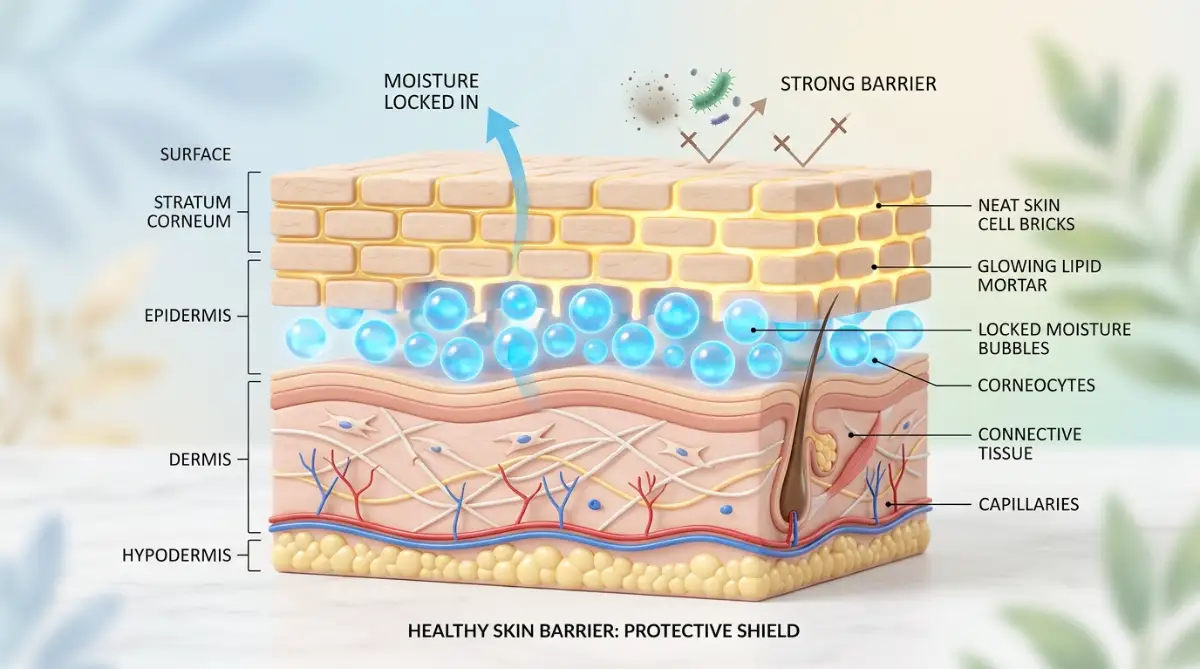
This wall keeps essential moisture inside your body.
It also keeps out harmful things like bacteria, dirt, and pollution.
When you over-exfoliate, you accidentally scrub away that helpful mortar.
Without the mortar, the bricks start to fall apart.
Water escapes your skin easily, leading to extreme dryness and dehydration.
Irritants can now enter easily, causing that angry redness and burning feeling you are experiencing.
Step 1: Put Your Skincare Routine on a Total Lockdown
The very first step is to stop using all active products immediately.
This means no salicylic acid, glycolic acid, lactic acid, or retinol.
You must also put away your physical face scrubs and cleaning brushes.
Even your beloved vitamin C serum needs to go on a break.
Your skin is currently raw and wounded, like a scraped knee.
You would not put harsh acid on a scrape, so do not put it on your face.
Keep these active products away for at least three to four weeks.
🛑 The 14-Day Product Swap Guide
To make this super easy for you, here is exactly what you should drop and what you should use instead for the next two weeks:
| ❌ Toss These in the Drawer | ✅ Keep These on the Counter |
| :--- | :--- |
| Foaming or gel cleansers | Milky, hydrating cream cleansers |
| Vitamin C and Retinol serums | Pure Hyaluronic Acid or Centella |
| Exfoliating acid toners (AHA/BHA) | Plain, lukewarm tap water |
| Lightweight gel moisturizers | Thick, heavy ceramide creams |
Only bring them back when your skin feels completely normal and comfortable again.
For now, simplicity is your absolute best friend.
Step 2: Switch to an Ultra-Gentle Cleanser
Washing your face should not feel like a painful chore.
If your skin feels tight or squeaky clean after washing, your cleanser is too harsh.
We want to clean the skin without stripping away any remaining natural oils.
Look for a non-foaming, creamy cleanser that is fragrance-free.
Ingredients like glycerin or oat extract are excellent because they soothe as they clean.
Avoid cleansers with sulfates, as they can worsen your dryness.
Use lukewarm water when you wash your face.
Hot water dries out the skin and can make redness much worse.
Gently pat your face dry with a clean, soft microfiber towel instead of rubbing it.
Step 3: Flood Your Skin with Deep Hydration
Now that your skin is clean, it is time to put back the water it lost.
We need humectants, which are ingredients that draw moisture into the skin.
Look for serums containing hyaluronic acid or panthenol.
Apply these hydrating serums while your skin is still slightly damp.
This helps lock in extra water and keeps your skin plump.
Imagine a dry sponge; it needs water first before it can become soft and usable.
Do not use products with heavy synthetic fragrances or drying alcohols.
These can irritate your vulnerable skin and set your progress back by weeks.
Keep the ingredient list as short and clean as possible.
Step 4: Rebuild the Mortar with a Rich Barrier Cream
Hydration is great, but we must lock that water in so it does not evaporate.This is where a rich, nourishing moisturizer comes into play.
You want a cream that contains ceramides, cholesterol, and fatty acids.These three ingredients mimic the natural lipids found in your skin barrier.
They act like fresh mortar that glues your skin cells back together.Using a ceramide cream is like giving your skin the exact building blocks it needs to heal.
Another amazing ingredient to look for is squalane.Squalane is a lightweight oil that mimics your skin's natural sebum.It softens dry patches without clogging your pores or causing acne breakouts.
Step 5: Apply a Safe Shield in the Evenings
During the night, your skin goes into a natural repair and healing mode.
You can help this process by applying a thin layer of an occlusive ointment.
Products like pure petroleum jelly or a heavy healing balm work wonders.
This creates a physical shield over your skin while you sleep.
It prevents water loss, a process scientifically known as transepidermal water loss.
Waking up with soft, calm skin is much easier when you use this trick.
If you have oily skin and worry about breakouts, do not be afraid.
Pure petrolatum molecules are too large to actually clog your pores.
However, if you still feel nervous, a rich cream with colloidal oatmeal is a great alternative.
Step 6: Shield Your Raw Skin from the Sun
A damaged skin barrier is highly sensitive to ultraviolet rays.Sun damage will slow down the healing process and make redness last much longer.
Therefore, wearing sunscreen every single day is absolutely non-negotiable.Choose a physical or mineral sunscreen containing zinc oxide or titanium dioxide.
Mineral sunscreens sit on top of the skin and reflect light like a shield.They are much less likely to cause a stinging sensation than chemical sunscreens.
Zinc oxide also has natural anti-inflammatory properties that calm irritated skin.Apply a generous amount every morning, even if you plan to stay indoors.Light from windows can still affect your recovering skin.
Myth vs. Reality: Clearing Up the Confusion
There are many misconceptions about how to treat damaged skin.Let us look at some common myths and find out the actual truth.
- Myth: "I need to scrub off the peeling, flaky skin to make it smooth again."
- Reality: Peeling skin is a sign of healing, not dirty skin. Scrubbing it will only tear the new, fragile skin underneath and make the damage worse.
- Myth: "If a product burns a little bit, it means it is working."
- Reality: Skincare should never burn or sting your face. Burning is a clear warning sign from your body that your skin barrier is in trouble.
- Myth: "Natural remedies like lemon juice or raw coconut oil will heal it faster."
- Reality: Lemon juice is highly acidic and will burn your skin. Coconut oil can clog pores for many people; stick to tested, fragrance-free skincare.
The Quick Reference Guide to Product Choices
To make things easy, here is a simple guide on what to use and what to avoid right now.
How Long Does the Healing Process Take?
Patience is your best friend when repairing your skin.
Your skin cells naturally turn over and renew every twenty-eight days.
Therefore, you should expect to see real improvement in about three to four weeks.
However, if the damage is severe, it might take up to six or eight weeks.
Do not get discouraged if your skin does not heal overnight.
Consistency with a gentle, basic routine is what brings long-term success.
If your skin continues to burn, bleed, or ooze, please consult a professional doctor.
Sometimes, a damaged barrier can lead to a skin infection that requires medical care.
Listening to your body is always the smartest move you can make.
Pro Tips to Avoid Over-Exfoliating in the Future
Once your skin is fully healed, you will eventually want to exfoliate again.
When that day comes, remember to go very slowly.
Limit your exfoliating products to just once or twice a week.
Never use chemical exfoliants and physical scrubs on the same day.
Listen to your skin's daily feedback.
If you notice slight redness or tightness, take a break for a few days immediately.
Skincare is not a race to see who can use the most active ingredients.
It is about supporting your skin so it can protect you naturally.
Treat your skin with kindness, and it will reward you with a healthy, beautiful glow.
Your Journey to Healthy and Happy Skin
Healing your skin is a journey that teaches you to listen to your body.You do not need a complicated shelf full of expensive products.All you need is time, gentle care, and a lot of patience.Keep things simple, stay consistent, and protect your face from the elements.Your skin has an amazing ability to heal itself when given the right tools.Soon, you will enjoy a strong, comfortable, and naturally radiant complexion again.
Read The Post Content – Segment 2
Pro-Level Secrets for Long-Term Barrier Health
Healing your skin requires more than just stopping your harsh scrubs. To get back that smooth, healthy complexion, you need to understand the daily habits that quietly affect your face. Let us look at some advanced secrets that dermatologists use to speed up skin recovery.
One major factor is the water you use to wash your face. Many people love a hot, steamy shower after a long day at work. However, hot water melts away the natural fats in your skin, leaving it dry and unprotected.
Always wash your face with cool or lukewarm water. This simple change prevents water from evaporating too quickly from your skin cells. According to research published by the National Institutes of Health, maintaining the correct skin pH and moisture levels is key to preventing long-term barrier damage.
Another secret is using a bedroom humidifier while you sleep. The air inside our homes is often very dry, especially when we use air conditioners or heaters. Dry air acts like a sponge, pulling water right out of your face while you rest.
A small humidifier adds clean moisture back into the air around you. This creates an environment where your skin does not have to fight to stay hydrated. You will wake up with much softer, calmer skin without changing a single product in your routine.
Next, look at the pH level of your daily skincare products. Your skin barrier is naturally acidic, with a pH of around five point five. Many foaming cleansers are too alkaline, which disrupts this natural protective acid mantle.
Switch to products that are explicitly labeled as pH-balanced or low-pH. This simple step allows your skin to repair itself without having to fight off harsh chemical imbalances. You can easily check product labels or search online to find the exact pH of your favorite face wash.
We must also think about how stress and lack of sleep affect our bodies. High stress levels trigger the release of a hormone called cortisol. Cortisol actively breaks down collagen and slows down the natural healing process of your skin.
Sometimes, people even go into credit card debt trying to buy every single luxury cream on the market. Understanding how to handle debt consolidation without hurting your credit score can save your financial health while you work on your physical health. Your skin reflects your internal peace, so taking care of your wallet is a great step toward taking care of your face.
If you ever find yourself taking out personal loans for expensive cosmetic treatments or dermatological procedures, check out our guide on avoiding common personal loan mistakes so you can make smart decisions. Always remember that healing a damaged barrier does not require fancy clinical treatments. Most of the work is done at home with simple, affordable ingredients and consistent, gentle habits.
Now, let us talk about your diet and how it feeds your skin cells. Your skin needs healthy fats to create the lipid barrier that locks in moisture. Eating foods rich in omega-three fatty acids can help rebuild your skin from the inside out.
Add things like wild-caught fish, walnuts, and flaxseeds to your daily meals. These healthy fats support your cells and reduce inflammation throughout your entire body. Drinking plenty of water throughout the day also ensures your cells have the hydration they need to function properly.
🩺 Real Talk: How long does this actually take?
You might be wondering: "Is my skin ruined forever?"
The honest answer: Not at all! While that horrible stinging feeling usually stops in just 3 to 5 days, a fully wrecked barrier takes about 28 days to completely rebuild itself. Do not get tricked by early results. Stick to your boring, gentle routine for a full month, even if your face feels "fine" after a week. Rushing back to your acids too soon will just restart the fire.

The Hidden Pitfalls: Mistakes That Keep Your Skin Red and Angry
Many well-meaning people make simple mistakes that accidentally prolong their skin's healing time. They think they are helping their face, but they are actually making the irritation much worse. Let us look at these common traps so you can avoid them completely.
The first mistake is testing too many new "barrier repair" creams at the exact same time. When your face is red and burning, your immediate reaction is to buy five different soothing products. You apply them all in a single night, hoping one of them will magically cure the pain.
However, your raw skin cannot handle a flood of new ingredients right now. If your skin reacts badly, you will have no idea which product caused the flare-up. Stick to one gentle, simple cream that you already know your skin tolerates well.
Another trap is stopping your recovery routine the very second your skin stops stinging. You might wake up with calm, normal-looking skin and think the job is done. Excitedly, you grab your strong glycolic acid or retinol to get back to your old routine.
This is a massive mistake because the deeper layers of your skin are still highly vulnerable. The top layer might look healed, but the underlying structure is still rebuilding itself. If you rush back to your active products too soon, you will reset your progress back to day one.
To understand how skin heals, we can look at studies from the American Academy of Dermatology Association. They explain that deep skin barrier recovery takes time and continuous, uninterrupted care. Give your skin at least a full month of gentle care before even thinking about exfoliating again.
We also see people turning to DIY "natural" remedies out of sheer desperation. They read online that applying raw lemon juice, apple cider vinegar, or baking soda will fix their issues. In reality, these ingredients are incredibly harsh and have completely wrong pH levels for your face.
Baking soda is highly alkaline and will completely strip your remaining natural fats. Lemon juice is extremely acidic and will cause actual chemical burns on an already damaged face. Just because an ingredient is in your kitchen does not mean it belongs on your sensitive skin.
Finally, watch out for the "over-washing" trap, especially if you have oily or acne-prone skin. When your barrier is stripped, your skin actually produces more oil to try and protect itself. This makes you think your skin is greasy, so you wash it three times a day to dry it out.
This constant washing creates a terrible loop of dryness and excess oil production. Instead of washing more, you need to moisturize more so your skin stops panicking. Trust your moisturizer to regulate your skin's natural oil production over time.
Your Daily Barrier Checklist: Action Plan for Strong Skin
Healing an over-exfoliated skin barrier can feel like a slow and frustrating process. However, with the right knowledge and a gentle routine, your face will recover beautifully. Every small, kind choice you make today helps your skin rebuild itself for tomorrow.
Remember to keep your routine basic, protect your face from the sun, and stay incredibly patient. Your skin is a living organ with an amazing natural ability to heal and protect itself. Give it the quiet time it needs, and you will soon enjoy a comfortable, glowing complexion again.
Do not let temporary setbacks discourage you on your skincare journey. Start your gentle routine tonight, and let your skin finally get the peaceful rest it deserves. A healthy, strong barrier is within your reach, one simple step at a time.
Disclaimer: The information provided in this article is for educational and informational purposes only. It is not intended to be a substitute for professional medical advice, diagnosis, or treatment. Always seek the advice of a qualified dermatologist or other licensed healthcare provider with any questions you may have regarding a skin condition or medical treatment."The content is not intended to diagnose, treat, or cure any disease."